 |
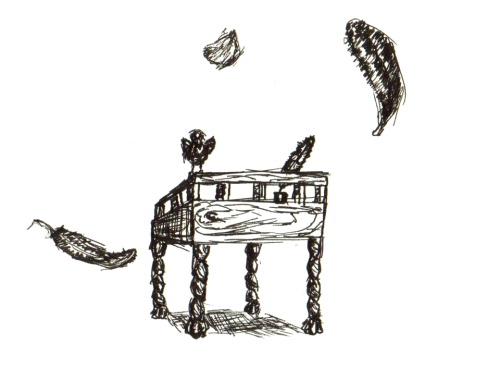
| Why is a raven like a writing desk? |
Wednesday, January 18, 2012


Ode on a Grecian Urn

Thou still unravish’d bride of quietness,
Thou foster-child of silence and slow time,
Sylvan historian, who canst thus express
A flowery tale more sweetly than our rhyme:
What leaf-fring’d legend haunt about thy shape
Of deities or mortals, or of both,
In Tempe or the dales of Arcady?
What men or gods are these? What maidens loth?
What mad pursuit? What struggle to escape?
What pipes and timbrels? What wild ecstasy?
Ode on a Grecian Urn— John Keats
So what are the two best known lines of this poem?
Thou foster-child of silence and slow time,
Sylvan historian, who canst thus express
A flowery tale more sweetly than our rhyme:
What leaf-fring’d legend haunt about thy shape
Of deities or mortals, or of both,
In Tempe or the dales of Arcady?
What men or gods are these? What maidens loth?
What mad pursuit? What struggle to escape?
What pipes and timbrels? What wild ecstasy?
Ode on a Grecian Urn— John Keats
So what are the two best known lines of this poem?
Wednesday, January 11, 2012
Cu Chulainn

(Death's Harbinger, C.nick Arach, 2012)
This is a depiction of the death of the Irish hero Cù Chulainn, Cù Chulainn was a feroucious fighter so much so that no one believed him dead until a raven appeared. Cù Chulainn's name comes from an incident in his youth when he killed a gaurd dog belonging to Culann, to make up for the death the then Sétanta changed his name and became the hound (Cù) of Culann gaurding Culann's house until a replacement could be trained. Because of that name sake Cù Chulainn has a geas (a taboo) placed on him forbidding him from eating dog meat, it is the breaking of this geis that marks the beginning of Cù Chulainn's death.
C.nick Arach
Beowulf
 |
| (Beowulf: Wyrd's Call, C.nick Arach, 2011) |
"The hoard-guard heard a human voice;
his rage was enkindled. No respite now
for pact of peace! The poison-breath
of that foul worm first came forth from the cave,
hot reek-of-fight: the rocks resounded.
Stout by the stone-way his shield he raised,
lord of the Geats, against the loathed-one;
while with courage keen that coiled foe
came seeking strife. The sturdy king
had drawn his sword, not dull of edge,
heirloom old; and each of the two
felt fear of his foe, though fierce their mood.
Stoutly stood with his shield high-raised
the warrior king, as the worm now coiled
together amain: the mailed-one waited." -Beowulf
Beowulf has been a favourite of mine ever since I was ten, for me at that age the story held adventures (with dismeberent) and interesting words (like Gloaming), I was pretty much in a sadistic literati barbarian child's heaven. Coming back to the poem as I grew older I became drawn to how the Beowulf poem deals with death, the inevitability of it, and how the poem shows that the dragon was alive as well and that two lives were lost. I am also fond of Wiglaf alluding to Beowulf's bravery might also be stubborn pride.
"At the mandate of one, oft warriors many
sorrow must suffer; and so must we.
The people's-shepherd showed not aught
of care for our counsel, king beloved!
That guardian of gold he should grapple not, urged we,
but let him lie where he long had been
in his earth-hall waiting the end of the world,
the hest of heaven.-This hoard is ours
but grievously gotten; too grim the fate
which thither carried our king and lord." -Beowulf
his rage was enkindled. No respite now
for pact of peace! The poison-breath
of that foul worm first came forth from the cave,
hot reek-of-fight: the rocks resounded.
Stout by the stone-way his shield he raised,
lord of the Geats, against the loathed-one;
while with courage keen that coiled foe
came seeking strife. The sturdy king
had drawn his sword, not dull of edge,
heirloom old; and each of the two
felt fear of his foe, though fierce their mood.
Stoutly stood with his shield high-raised
the warrior king, as the worm now coiled
together amain: the mailed-one waited." -Beowulf
Beowulf has been a favourite of mine ever since I was ten, for me at that age the story held adventures (with dismeberent) and interesting words (like Gloaming), I was pretty much in a sadistic literati barbarian child's heaven. Coming back to the poem as I grew older I became drawn to how the Beowulf poem deals with death, the inevitability of it, and how the poem shows that the dragon was alive as well and that two lives were lost. I am also fond of Wiglaf alluding to Beowulf's bravery might also be stubborn pride.
"At the mandate of one, oft warriors many
sorrow must suffer; and so must we.
The people's-shepherd showed not aught
of care for our counsel, king beloved!
That guardian of gold he should grapple not, urged we,
but let him lie where he long had been
in his earth-hall waiting the end of the world,
the hest of heaven.-This hoard is ours
but grievously gotten; too grim the fate
which thither carried our king and lord." -Beowulf
C.nick Arach
Thursday, November 3, 2011
Yggdrasil

For those of you who are not familiar with Norse myth, an ash tree called Yggdrasil is the world tree its roots reach the nine worlds, Midgard, Asgard, Hel and Nifelheimr etc. At the top sits an eagle and at the bottom lays Níðhöggr a serpent/dragon, carrying hostile messages between the two is a squirrel called Ratatoskr. As you can see I have drawn a more realistic interpretation of Yggdrasil and I hope you enjoy the different perception.
C.nick Arach
Monday, October 31, 2011
Gwrach y Rhibyn
 (Gwrach y Rhibyn, C.nick Arach 2011)
The Gwrach y Rhibyn is a Banshee like figure (though a little more violent) from welsh legend. Families that have been in Wales for centuries (the "true" welsh) are said to have the Gwrach y Rhibyn vist them when one of them dies.
Calan Gaeaf Hapus,
C.nick Arach
Friday, December 24, 2010
Sir Gawain & the Green Knight
 (A Prayer for Christmas Eve, C.nick Arach, 2010)
"Thus in peril and pain and plights hard through the
country wanders this knight all alone til Christmas eve. At that tide to
Mary he made moan that she might direct his riding and lead him to
some dwelling."
Sir Gawain and the Green Knight, translated by W.A. Neilson
C.nick Arach
C.nick Arach
Subscribe to:
Posts (Atom)
Popular Posts
-
 ("Is that a Dagger that I see before me?", C.nick Arach, 2010) This drawing was inspired by the dagger scene from Macbeth: ...
 -
Louise, Graphite, 3.5 X 5in/ 8.9 X 12.7cm, C.nick, 2013 Louise Élisabeth Vigée Le Brun is one of the artists I admire mos...
-
Anna Murray-Douglass was an exceptional person. This mini drawing is in honor of her and black history month.
-
(The Fair Emily, C.nick Arach 2010) These sketches come from the story "The Knight's Tale" from the "The Canterbury Tal...


